Saturday, July 13, 2013

Wading up the Salmon (Day Twenty)

Exiting our unofficial campground on (most likely) BLM land lining the Salmon, we continued our journey following this river upstream. High rocky cliffs with sparse vegetation- Ponderosa and Juniper with footholds near the peaks, sagebrush spilling down the loose, gravelly sides - bordered the road. The road cut itself seemed unnatural and difficult to maintain. Creation of the road bed, a uniquely flat space in this sharply angled land, must have removed the footing of many the steep hills lining the road. Vast slides of bare soil and rock extended up the hills from the road, vegetation only stabilizing the dry, rocky soil after hundreds of vertical feet. Metal netting covered other areas to prevent rocks from hurtling onto the road, and "Watch for Rock" signs are common.

Within the steep-walled Salmon River valley, not only does the water flow downhill, but the wind as well. As the Salmon work their way against water current to the spawning ground they remember, we labored against air current to gain distance.

Many hard-won miles later, brightly colored flapping flags drew us on. Nummyz, the only Korean-esque food within at least a 200 mile radius, is housed in a hand-built, airy structure. After good food and writing our blog address on their walls reminiscent of Dazzo's in Arizona, we gritted our teeth to finish the last ten miles to Challis.

We rode up the main street of Challis, Kevin casting extreme doubt on Laura's hope of finding self-serve frozen yogurt. With mostly bars and saloons lining the wide, empty street, this doubt seemed well-founded. But near the top of the long hill, just before the pavement turned to gravel, sat a new, fancy building advertising itself as the Teacup Cafe. Maybe too much investment for one small town... but the frozen yogurt was delicious. Refreshed, and with instructions that Bayhorse was the last place to stay before a long campground-less stretch, we headed out.

After a long day fighting headwind and gradual elevation gain, we were glad to pull into Bayhorse, despite it being a feed campsite ($10/night). The whole day had been overcast (and to our relief, cool), but we wondered if it might rain in the night. Talking with the camp hosts assured us it would not. Preparing our dinner, we met several other camp residents who, interested in our journey, came over to introduce themselves. Mike was from Blackfoot, and Becky and Jerry were from, unbelievably, Fallon, NV, with which we were only familiar because of our Portland to Phoenix trip. We shared their campfire and stories of epic motorcycle trips, adobe houses and their dog Sally.

Snug in our down bags, sleep nearly had us, when the still air suddenly kicked into ~50 mph winds. Securing our gear and throwing a tarp over ourselves, we went back to sleep. Sometime deep in the night, awakened by full bladder, the sky had cleared revealing a brilliant milky way shining through the still air.

Thursday, July 11, 2013

Salmon, ID and Cabin Creek (Day Nineteen)

After a big breakfast of Bubba's English Muffins, we escaped from our box unscathed. Then we were off to find the ideal blog writing headquarters within the town of Salmon. Much was accomplished at the Coffee Shop, which was actually a diner. One can only sit in a diner and drink coffee for so long, so we continued in the direction of the Sacagawea Center. Seeing signs asking a fee to be paid, we were prepared to leave, but scouted the outskirts anyway. We soon met the host who let us know that there was indeed a bicycle shop in this small town.

Not sure what to expect, we followed his directions to The Hub, a recently opened bike shop and bar combo. Perfect for cycle tourists, Kevin was able to find and install the new rear tire he needed while Laura drank cider, ate rosemary pizza, and continued to write while sitting in a comfy chair in an air conditioned room. With courtyard, live music, and bar stools made out of horse saddles, this was a fun place and we wish their business well. Retuned, refueled, and refreshed, we pointed our wheels south out of town with a small amount of regret as the evening string band began to play.

Sprinting along the edge of the flawlessly straight highway south out of town, we rushed to escape the farm fields and higher traffic volumes. Soon we joined the bank of the Salmon River once again, winding into steepening canyons of the ancient river gorge.

Dreaming of water colder and cleaner than the warm stuff left in our bottles, we paused at a homestead in a curious S bend. Greeted cheerfully and our bottles quickly filled with cold, delicious well water, the owner of this stretch of river, proud of his unique and beautiful land, let us know that Sacagawea and her people would fish and camp along this unusually protected stretch. During the winter, the high canyon walls and curve of the river leave it relatively protected from harsh weather. With a reminder not to go stomping in the brush with exposed ankles (rattlesnakes) we were on our way.

Several miles closer to Challis, we spied an inviting sandy beach on a grade lower than the highway. Ponderosa, soft sand, campfire ring already built, we heated a rock for tortillas and had an all-you-can-eat taco buffet. With an abundance of both bats and swallows on patrol, we enjoyed a night free of flying, biting insects.

Wednesday, July 10, 2013

City in the Forest (Day Sixteen)

The pounding of the drum circle still sounded through the forest and sagebrush meadows as we woke near dawn. Rolling over for a cool morning nap, we were finally refreshed as the drummers stopped and the sun rose higher.

Having entered the Gathering at sunset, led to our campsite in the dark, we were as good as lost in the outskirts of an unfamiliar city. Excited for the change of pace, we soon set out to learn the layout and habits of our surroundings. Pancakes and coffee from the kitchen Montana Mud got us started, soon followed by our own usual, more whole grain breakfast of Malt o Meal, raisins, and dark chocolate amazing mush.

Forest paths meandered through endless tent neighborhoods - we followed them back to the information booth and message boards, then through the Trading Circle. Having heard there was a lake to the west, we found a Forest Service trail headed that direction and soon came to the lake and icy creek feeding it.

After shared watermelon and a quick dunk in a built-up chill pool, we walked back to the metropolis through Lodgepole forest and grass/sagebrush clearings. Unlike our Nevada and Eastern OR observations, the sagebrush here had many vascular plant companions. Red paintbrush, blue lupine, succulent Sedum, yarrow, mariposa lilies, a grass-look-alike with flowers that were definitely not grass flowers, and many unknowns gave cover to the rocky soil below the taller sagebrush.

Nearing the populated forest once again, we took a slightly different angle of approach and found ourselves quickly in unfamiliar surroundings. More kitchens, structures, tepees, and an undulating, smoothly worn dirt path as wide as a city street added to the complexity of our growing mental map. Back to known territory and eventually camp after a dead-reckoning shortcut through an open stand of young trees, we prepared to cook the can of tiny shrimp found roadside several days past. But before we began, our campmates returned and let us know that Evening Circle was beginning.

Enticed by the promise of vegan curry, we made the trek to Main Meadow. Finding a small gap in the vast, concentric rings of seated people, we settled in and pulled out our personal eating gear. Many passes of large pots later, their contents of mashed potatoes, bean sprouts, rice, bean soup, pasta, tomato sauce, quinoa, and garbanzo bean curry ladled out by cheery volunteers, we laid back in the sunny grass, exceptionally well-fed. Our bodies tuned to make quick use of these nutrients, the food coma didn't last long.

After determining that another man-on-a-bike had ridden just from the parking lot, we fell into conversation with a cycle touring Belgian couple we had met earlier. They also had ridden the 8 miles of gravel into the Gathering site, with much more gear and a small child in tow. Impressive!

After an evening camp fire shared with neighbors, we dragged our sleeping gear further from the ruckus and fell asleep to distant drumming once again.

r

Beaverhead Deerlodge National Forest - Ecological observations west of Jackson, MT

Having crossed the Continental Divide and then worked our way out to a section of National Forest in the Montana foothills of the Bitteroot Mountains, I was eager to explore this unknown land rife with foreign plant combinations.

The first surprise was how often and suddenly the trees gave way to sagebrush meadows. Possibly moisture availability makes the sharp delineations between stands of Lodgepole pine mostly higher on the hills and the expanses of sagebrush meadow that tend to fill the lower dips in terrain. Sagebrush, a fragrant woody shrub that solely covers enormous expanses of dry land in western America, was here accompanied by many smaller vascular plants offering color with their blooms.

High on the rounded hills, the Lodgepole once again dropped off, giving way to fields of lupine and - big Surprise! - individuals of Pseudotsuga, while not rivaling our west-of-the-Cascades giants, larger than any of the Lodgepole pine trees and obviously ancient with their deeply riveted orange-brown bark, large dead branches, and majestic form. Is this the same Pseudotsuga menzesii, Douglas-fir, that is our constant companion in the Northwest? With mouse-tail cones, the signature bark pattern, and similar foliage, it might seem so. The more smoothly conical growth form may be caused just by environment, or this may be a more genetically distant Pseudotsuga...

The strangeness of finding this familiar face so far from home climate was furthered by the habits of its young. Back down the slopes, beneath the slim and numerous Lodgepole trunks with their flaky bark, the same Pseudotsuga formed an understory. In the temperate rainforests of Cascadia, Douglas-fir does not reproduce in the shade of other trees, but is overtaken by later successional species. Here, along with an occasional spruce, Pseudotsuga forms the next generation.

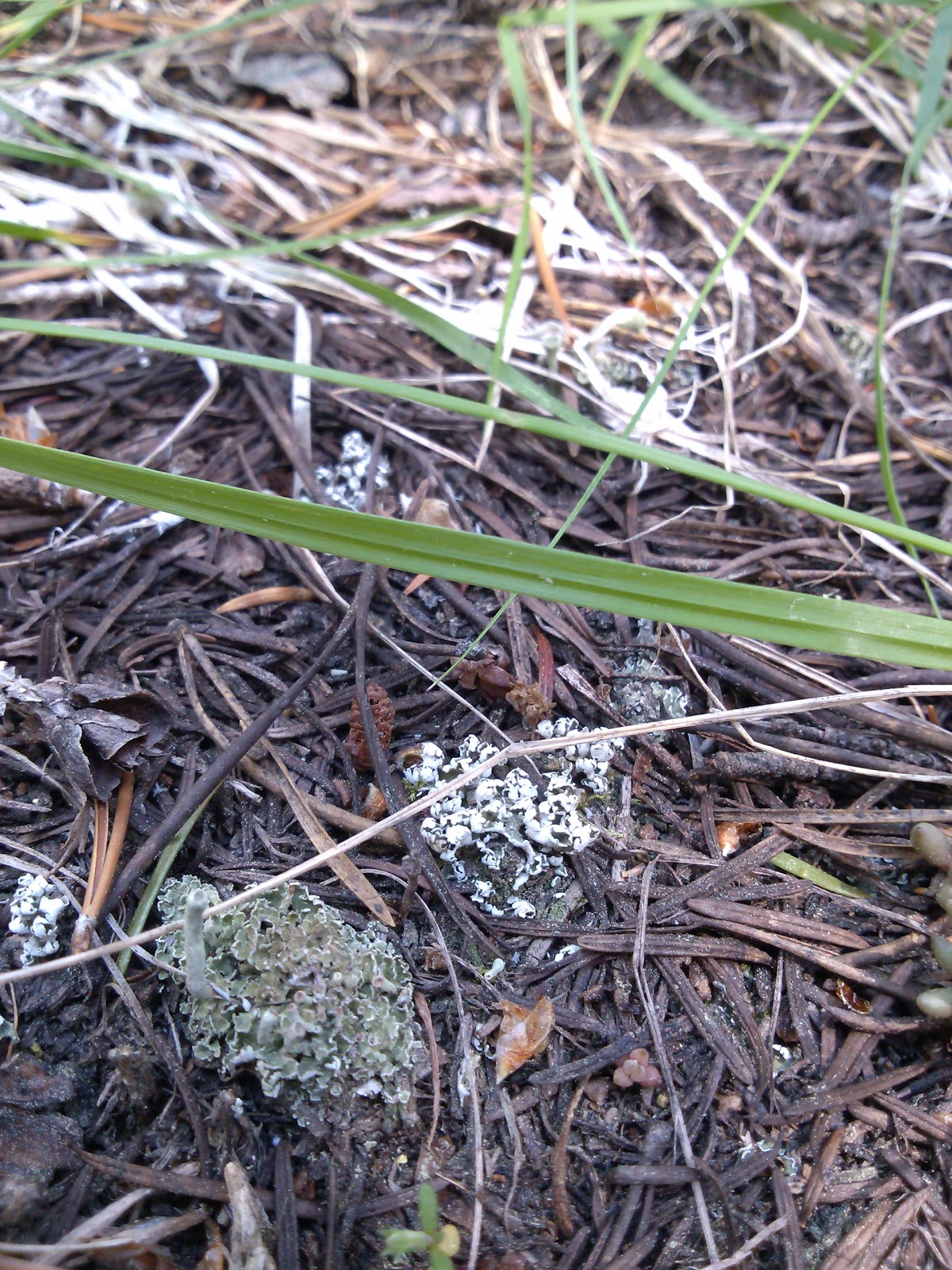
It must be the dryness of this environment that makes the species composition on some patches of ground look something like the edges of old Forest Service roads in wetter climes. Folious lichens like dinner plates, Cladonia, bits of Sedum, and sparse grasses along with tree litter try their best to keep the soil covered.